
Understanding Florida's "Save Our Homes From Excessive Property Taxes" Proposal (HJR 1-F) in Davenport
The Quick Read
Florida's HJR 1-F proposal is a constitutional amendment designed to offer property tax relief to homeowners, potentially by expanding homestead exemptions or adjusting assessment caps. For Davenport residents, this measure aims to bridge the gap between rapidly rising market values near growth corridors like Posner Park and the assessed values seen on annual TRIM notices. However, because non-ad valorem assessments and school taxes typically remain unchanged, this proposal represents targeted relief rather than total property tax elimination.
Market Price Impact: Davenport’s rapid appreciation has widened the gap between market value and assessed value, exposing newer buyers to higher starting tax bases compared to long-time owners.
Market Vibe: Communities near major employment engines like Walt Disney World are seeing massive equity jumps, making tax caps a critical issue for retaining long-term residents.
Schools: School-related taxes are frequently treated differently in reform proposals and usually remain a significant, untouched portion of your overall tax bill.
Commute & Infrastructure: Non-ad valorem assessments that fund essential local services like solid waste and stormwater management are generally not affected by constitutional property tax changes.
If your Davenport tax bill feels disconnected from what you paid for your home a few years ago, you are seeing the gap between Florida's fast-moving housing market and its slower tax protections.
For homeowners trying to interpret the Florida property tax law proposal Save Our Homes From Excessive Property Taxes (HJR 1-F), the central question is not whether reform sounds appealing, but how a constitutional change could alter taxable value, exemptions, and future bill growth. This guide explains what HJR 1-F is, how Florida property taxes work now, and how Davenport residents can estimate what any final ballot measure could mean.
What HJR 1-F Is and Why Davenport Homeowners Are Paying Attention
CS/HJR 1-F (sometimes written as HJR 1-F) is a Florida House of Representatives joint resolution that would place a constitutional amendment on a future ballot as a statewide ballot measure. CS/HJR 1-F, sometimes discussed alongside HJR 203 and companion Senate language such as CS/SJR 2-F, is a property tax reform proposal tied to the Florida Constitution rather than a routine statute. That distinction matters because a constitutional amendment can reshape long-term tax rules for homesteaded property in ways that ordinary session law cannot undo easily.
In plain English, HJR 1-F is a ballot measure proposal framed to reduce or limit property tax pressure on homeowners, but the details depend on the final text and ballot language. Davenport residents are paying attention because rapid appreciation in Polk County has turned paper equity into higher tax exposure, even for owners who are not selling.
Because it is a Florida Constitution change, the proposal must move through the legislative process, including committee stops and floor votes, before it can appear on the ballot, and voters must approve it by at least 60% statewide. A joint resolution is the legislative vehicle Florida uses to propose constitutional amendments, and it can be considered during a regular or special session. The practical takeaway is that homeowners should treat headlines as provisional until the final text, ballot summary, and implementing rules are settled.
Decoding Your Polk County Tax Bill
To understand how HJR 1-F will impact you, it is vital to know how Florida property taxes currently operate. A standard Florida property tax bill starts with the taxable value, applies a millage rate set by local taxing authorities, and then adds any non-ad valorem assessments.
-
Market Value: This is what your property could likely sell for in the current Central Florida real estate market.
-
Assessed Value: This is the value used for tax purposes after applying legal limits, such as the Save Our Homes protections for qualified homesteads.
-
Taxable Value: This is the assessed value minus any eligible exemptions, which directly drives your ad valorem tax bill projection.
The Save Our Homes assessment cap currently restricts annual assessed value increases on a homestead to the lesser of 3% or the Consumer Price Index (CPI). While this protects long-time homesteaded owners, it does not freeze taxes entirely; if local millage rates rise or non-ad valorem charges increase, your total bill can still go up.
Predicting the Impact on Your Davenport Property
The broad aim of HJR 1-F is to expand homeowner protection, often through an expanded homestead exemption or revised Save Our Homes limits. However, it is essential to look at the details:
-
First-Time Buyers in Davenport: A recent buyer typically starts with a taxable value close to the purchase price, meaning year-one taxes can feel disproportionately high. If HJR 1-F expands exemptions, these buyers could see highly visible relief.
-
Long-Time Owners: Those with a large Save Our Homes differential may see a smaller percentage of relief because current laws already suppress their assessed value growth.
-
Investors: Non-homestead owners, including those with vacation rentals near Walt Disney World, may receive little or no benefit, as reform language heavily favors primary residences.
To grow your financial security and navigate these changes with absolute clarity, we recommend pulling your latest Polk County Property Appraiser record and running a side-by-side comparison of your ad valorem taxes versus non-ad valorem assessments.
Pros of HJR 1-F
- ✅ Expanded Exemptions: Potential for increased homestead exemptions for primary residences.
- ✅ Taxable Value Relief: Directly targets lowering the taxable value on TRIM notices.
- ✅ Homestead Portability: May offer enhanced portability benefits when downsizing.
Cons / Limitations
- ❌ Investors Excluded: Likely provides zero relief for non-homestead properties or second homes.
- ❌ Schools Untouched: Does not typically lower school-related tax assessments.
- ❌ Non-Ad Valorem: Stormwater and solid waste fees remain unaffected.
How Florida Property Taxes Work Today (Baseline Before Any Change)
A Florida property tax bill starts with taxable value, applies a millage rate, and then adds any non-ad valorem assessments. That formula means a homeowner in Davenport or nearby ChampionsGate can see taxes rise even when assessed value growth is capped, because millage and separate assessments operate on different tracks.
In Polk County, the property appraiser determines value, taxing authorities set rates, and the tax collector sends and collects the bill. This division of responsibility matters because homeowners often blame one office for changes made by another.
School taxes are often treated differently in reform proposals, and many versions of tax relief do not erase that portion. Exemptions and portability remain central stabilizers for owner-occupied homes because they reduce taxable value and preserve some accumulated benefit when an owner moves.
The Save Our Homes Assessment Cap (What It Does and Doesn't Do)
The Save Our Homes assessment cap is the constitutional limit that generally restricts annual assessed value increases on a homestead to the lesser of 3% or CPI (a measure of inflation), until a change in ownership or another exception resets the assessed value closer to market value. Save Our Homes usually limits annual assessed value growth on homesteaded property, subject to Florida law and exceptions such as ownership changes. In high-appreciation regions influenced by employment engines like Walt Disney World, that cap can create a large difference between market and assessed value over time.
The cap does not freeze taxes. If millage rates rise or non-ad valorem charges increase, the total bill can still rise even when assessed value growth remains limited.
Where Your Bill Goes: Taxing Authorities You'll See on a TRIM Notice
A TRIM notice usually lists the county government, the school board, a city (if applicable), and special districts. Many homeowners miss that each line item can respond to a different budget decision, which is why one reform proposal rarely changes every charge on the page.
TRIM stands for"Truth in Millage,” and the notice is your best snapshot of how assessed value, taxable value, exemptions, and each taxing authority's proposed millage rate combine to create your estimated ad valorem tax.
Non-ad valorem assessments appear separately and may include items such as solid waste or stormwater. Those charges are a common source of confusion because constitutional property tax changes do not always affect them.
| Value Type | Definition | Impacted by HJR 1-F? |
|---|---|---|
| Market Value | What the home would sell for today. | No (Determined by real estate market) |
| Assessed Value | Value used for taxes after legal caps. | Yes (Subject to new caps) |
| Taxable Value | Assessed value minus exemptions. | Yes (Subject to expanded exemptions) |
What HJR 1-F Proposes to Change (Conceptual Summary)
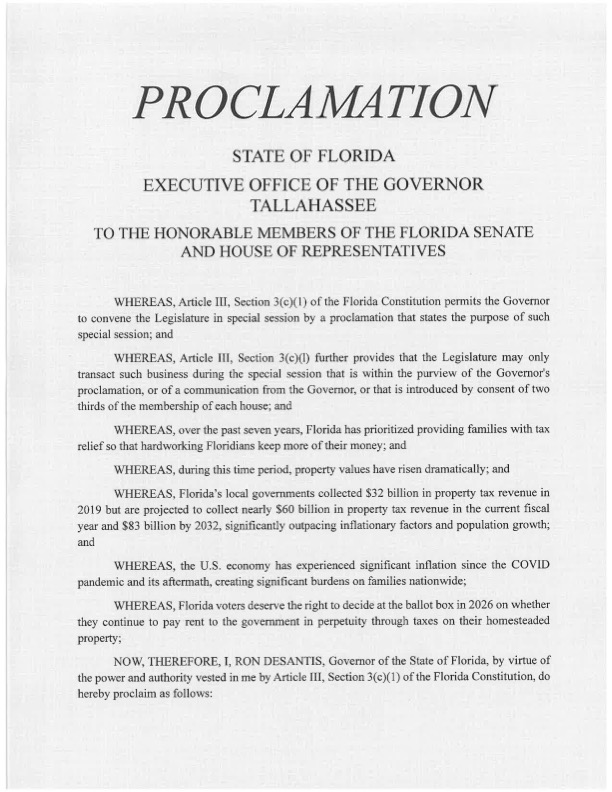
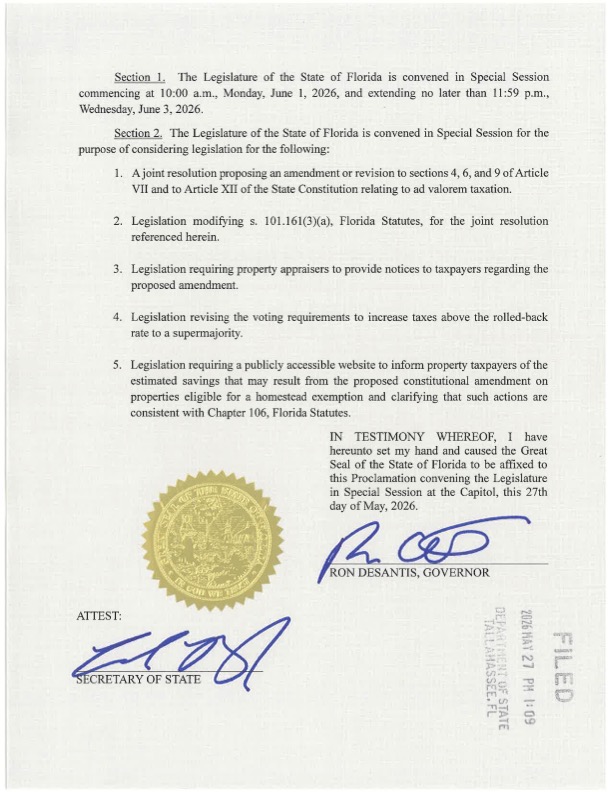
The broad aim of HJR 1-F is to expand homeowner protection from sharp tax increases, often through some combination of an expanded homestead exemption, revised Save Our Homes limits, or added constitutional caps. The phrase" property tax relief" is accurate; "property tax elimination" is often not.
Because headlines can lag behind amendments, the most accurate way to understand what HJR 1-F would do is to read the bill text and ballot summary on official sites, then confirm whether there is companion language (CS/SJR 2-F) or earlier concepts (HJR 203) that were folded into the final version. Public coverage has framed the proposal as a way to protect primary residences from excessive tax growth. Still, the final impact depends on the adopted text and any follow-up legislation. That is why summaries on advocacy pages, media reports, or even references from exitrealty4corners.com should be treated as directional rather than definitive.
Long-time homesteaded owners may gain incremental relief because they already benefit from capped assessed growth, while recent buyers could see a larger relative benefit if exemptions expand. Non-homestead owners may receive little or nothing, which is why investors should read every eligibility clause before modeling savings.
What Typically Would Not Change: School-Related Taxes and Non-Ad Valorem Items
Many reform analyses stress that school-related taxes may remain untouched under certain versions of the proposal. That detail matters more than campaign language, because the school portion is often large enough to limit the visible savings on a total bill.
Stormwater, solid waste, and similar non-ad valorem assessments may also stay in place. When you’re estimating savings, the most useful interpretation is the least dramatic one: tax reform can lower part of a bill without changing all of it.
Step-by-Step: How to Estimate Your Potential Impact in Davenport
Start with your latest TRIM notice and separate ad valorem taxes from non-ad valorem assessments. That single step prevents the most common forecasting error, which is assuming every line on the bill would fall if HJR 1-F passes.
Next, compare your current taxable value with a modeled scenario under the proposal, such as a larger exemption or slower assessed value growth. A useful estimate is not a prediction of politics; it is a structured comparison built on transparent assumptions.
Step 1: Pull the Right Documents
Your TRIM notice shows current and prior values, proposed millage, and taxing authorities. Your property appraiser record shows market value, assessed value, exemptions, and any Save Our Homes history, which together reveal whether your tax burden is being driven by value growth or by rates.
If you cannot find your Save Our Homes differential, look for the gap between market value and assessed value on the property appraiser page, because that spread is often a "he “hi"den” benefit that can be lost or transferred when you move.
Step 2: Run a Simple Year-by-Year Projection
Project assessed value under current Save Our Homes rules, then run a second scenario using the proposed change. Keep millage constant first, then test a small increase and decrease, because local budgets can offset part of any constitutional savings.
Basic formula: (taxable value / 1,000) x millage rate = estimated ad valorem tax, then add non-ad valorem assessments to estimate the total bill.
Step 3: Sanity-Check With Local Reality
If your bill includes large non-ad valorem charges, your total savings may look smaller than expected, even if ad valorem taxes fall. If you are not homesteaded, your scenario may not apply at all, which is why eligibility matters as much as headline language.
For rough comparisons, some owners use a Save Our Homes tax savings calculator and then cross-check the results against their TRIM notice and the county appraiser's records. A second reference from a third-party explainer can help you understand how the proposal is being framed, but it should still be compared with the official bill text.
For official sources, use the Florida Legislature sites for bill text and analyses: Florida House (flhouse.gov) and Florida Senate (flsenate.gov). If you see a press release or executive commentary, cross-check on flgov.com for context, but rely on the bill pages for the operative language.
Homestead Protection Timeline Roadmap
Visualizing how deductions and indexing apply to existing vs. new residents under proposed reform pathways.
Examples for Davenport Households (Practical Scenarios)
A first-time homestead buyer in Davenport often starts with a taxable value close to the purchase price, so year-one taxes can feel high compared with a neighbor who bought years earlier. If HJR 1-F expands exemptions, the buyer could see more visible relief because there is less existing Save Our Homes shelter built into the assessment.
A long-time owner with a large Save Our Homes differential may gain less in percentage terms because the current law already suppresses assessed value growth. That does not make reform irrelevant; it means the benefit may be additive rather than transformative.
An investor or second-home owner may see little change if the proposal targets homesteads. A downsizing homeowner should also examine homestead portability, because moving can preserve part of an accumulated tax benefit and may matter as much as any new amendment.
Approval Process, Timeline, and What to Watch Next
A constitutional amendment in Florida must clear the legislative process before voters see it on the ballot, and final approval requires the applicable voter threshold. For that reason, status on the Florida House of Representatives site matters more than commentary, because a proposal can be amended, delayed, or replaced before election season.
Watch official bill pages for referrals, staff analyses, amendments, and companion movement in the Senate. The most reliable signal of momentum is not media volume but procedural progress through committees and floor votes.
Where to Track Official Progress
Check Florida House and Senate bill pages for text, committee calendars, amendments, and related measures. Comparing versions side by side is the fastest way to see whether HJR 203 language evolved into CS/HJR 1-F or whether CS/SJR 2-F introduced a different structure. You can track progress here CS/HJR 1-F: Save our Homes from Excessive Property Taxes
If It Passes: Implementation vs. Immediate Savings
Passage does not always produce instant savings on the next bill, because an amendment can take effect in a later tax year, and bills reflect the year’s values and rates. Some reforms apply in a later tax year or require follow-up legislation, and local millage decisions still shape the final number, which is a useful reminder in a media agency-first approach to policy analysis: timing affects value as much as headline content.
Also, watch for legislation implementing the administration of the county property appraiser and tax collector, because constitutional language often needs statutory detail to define forms, deadlines, and calculation steps.

Common Misunderstandings and Costly Mistakes to Avoid
The biggest mistake is treating an assessed value cap as a guarantee that taxes cannot rise. Taxes can still increase through millage changes or non-ad valorem assessments, so any estimate that ignores those components is incomplete.
Another mistake is assuming property tax elimination applies to rentals, vacation homes, or all tax lines on the bill. Most reform language focuses on homesteaded primary residences, meaning property's legal classification matters as much as the dollar amount.
Red Flags in Headlines and Social Posts
Be cautious with posts that skip the words proposal, ballot, or subject to voter approval. If an article does not separate ad valorem taxes from non-ad valorem charges, it is not giving you a usable estimate.
Missing homestead deadlines is another costly error. A homeowner who qualifies but fails to file can lose benefits that no later amendment automatically restores.
Finally, avoid assuming “assessed value” " and “taxable value” are interchangeable. Exemptions can materially reduce taxable value even when the assessed value is unchanged.
Key Takeaways for Davenport Residents
HJR 1-F is best understood as a proposal to strengthen homeowner tax protections, not as a promise that property taxes disappear. Your outcome depends on homestead status, current taxable value, existing Save Our Homes differential, and local millage choices in Polk County.
The most practical response is to use your TRIM notice as a planning tool rather than a year-end surprise. That approach aligns with the data-driven perspective of exitrealty4corners.com: clear inputs lead to better household decisions than broad political slogans.
💡 EXIT Realty 4Corners Broker Tip
Don't assume your property tax will disappear. Always separate your ad valorem taxes from your non-ad valorem assessments on your TRIM notice before estimating any potential savings. If you are planning a move to a new Davenport new construction, model your homestead portability alongside any new exemptions, as transferring that benefit can save you more than a standard cap adjustment.
A Practical Next Step Checklist
-
Confirm your homestead exemption status and review any portability benefit you may carry.
-
Save your latest TRIM notice, then run two scenarios: current law and the proposed change.
-
Separate ad valorem taxes from non-ad valorem assessments before estimating savings.
-
Track official bill text and ballot language instead of relying on summaries alone.
-
If you are planning a move, model homestead portability alongside any expanded homestead exemption, because portability can change your taxable value more than a small cap adjustment.
Frequently Asked Questions
Local insights for Davenport and the Four Corners area.
+ What are the current real estate market trends in Central Florida, particularly around Davenport and the Four Corners area?
+ Can I buy a short-term rental or Airbnb property anywhere in Central Florida?
+ What hidden costs should I expect when buying a home in the Central Florida area?
+ What should I consider when choosing between new construction homes and resale properties in the Central Florida/Four Corners region?
+ Why should I work with a specialized agency located in the Four Corners/Davenport region rather than a national brokerage?
Recommended Reading:
-
Investment Opportunities: Why Davenport’s Real Estate Market Is Booming
-
The 2026 Outlook: Davenport, Florida Real Estate Market Trends
External Market Authorities:
Categories
Recent Posts









"My job is to find and attract mastery-based agents to the office, protect the culture, and make sure everyone is happy! "
49503 Hwy 27 Suite B, Davenport, Fl 33897, United States